
Podcasting is increasingly becoming an essential fan engagement and communication channel for rights holders. The next challenge is ensuring those content investments deliver their full commercial potential.
Rather than viewing a podcast as a single sponsorship asset, rights holders should be commercialising it in the same way they package a club, competition or media property: as a collection of inventory that can solve different objectives for different partners.
A front-of-shirt sponsorship is built around visibility and scale. Podcast sponsorship is built around attention, trust and message delivery. Those are different strengths, and they should be sold differently.
The value of that attention continues to be backed up by audience data. The Advertising Landscape UK study found that 79% of UK podcast listeners recalled hearing a podcast advertisement in the previous week, while 44% reported making a purchase after hearing a podcast advert. Among listeners, 56% consume podcasts daily or almost daily. (Sounds Profitable / Podnews)
That level of engagement creates a significant opportunity for rights holders. Rather than offering a single sponsor logo and one host-read mention, podcasts can support multiple commercial partners across different inventory types, all within the same content ecosystem.
The key is to think beyond the podcast episode itself. Every recording creates a range of assets that can be packaged, measured and sold according to the value they deliver.
The trick is identifying the outcome that your commercial partner was and offering the most effective content solution. Some brands want awareness, others want consideration, audience engagement or measurable action. The strength of podcasting is that a single piece of content can deliver each of those objectives through different inventory types, creating opportunities for multiple partners without compromising the listener experience.
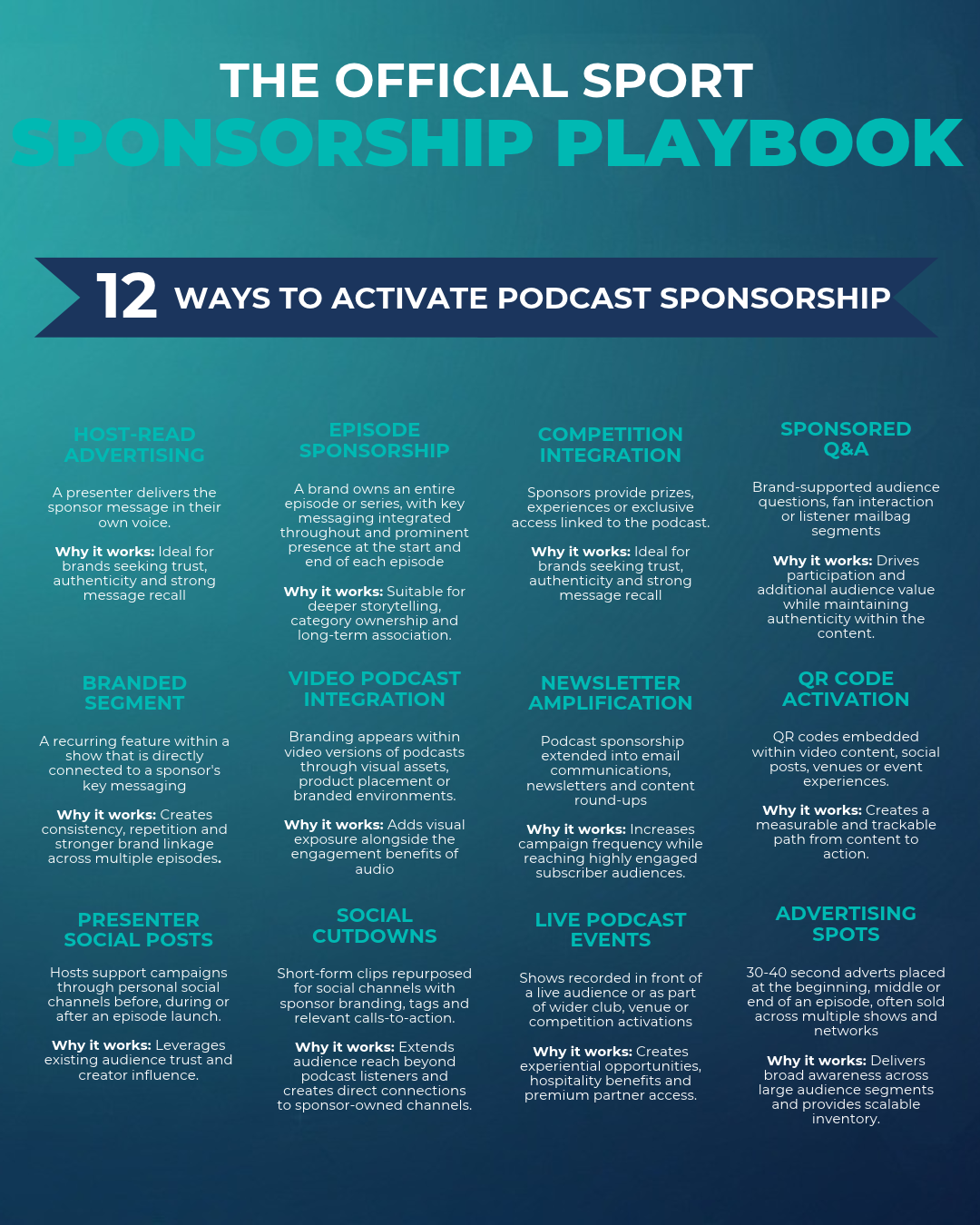
Depending on the format of the show, each episode can generate a range of commercial assets. While not every opportunity will be suitable for every podcast, rights holders can build tailored sponsorship packages using a combination of the following inventory types.
Podcast Sponsorship & Commercialisation Glossary
Host-Read Advertising: A presenter delivers the sponsor message in their own voice.
Why it works: Ideal for brands seeking trust, authenticity and strong message recall.
Episode Sponsorship: A brand owns an entire episode or series, with key messaging integrated throughout the show and prominent presence at the start and end of each episode.
Why it works: Suitable for deeper storytelling, category ownership and long-term association.
Branded Segment: A recurring feature within a show that is directly connected to a sponsor's key messaging.
Why it works: Creates consistency, repetition and stronger brand linkage across multiple episodes.
Video Podcast Integration: Branding appears within video versions of podcasts through visual assets, product placement or branded environments.
Why it works: Adds visual exposure alongside the engagement benefits of audio.
Social Cutdowns: Short-form clips repurposed for social channels with sponsor branding, tags and relevant calls-to-action.
Why it works: Extends audience reach beyond podcast listeners and creates direct connections to sponsor-owned channels.
Highlight Reels: The most engaging moments from an episode repackaged as sponsored content.
Why it works: Delivers scale, shareability and high levels of engagement.
Live Podcast Events: Shows recorded in front of a live audience or as part of wider club, venue or competition activations.
Why it works: Creates experiential opportunities, hospitality benefits and premium partner access.
Sponsored Q&A: Brand-supported audience questions, fan interaction or listener mailbag segments.
Why it works: Drives participation and additional audience value while maintaining authenticity within the content.
Competition & Giveaway Integration: Sponsors provide prizes, experiences or exclusive access linked to the podcast.
Why it works: Generates audience participation and creates valuable first-party data opportunities.
QR Code Activation: QR codes embedded within video content, social posts, venues or event experiences.
Why it works: Creates a measurable and trackable path from content to action.
Newsletter Amplification: Podcast sponsorship extended into email communications, newsletters and content round-ups.
Why it works: Increases campaign frequency while reaching highly engaged subscriber audiences.
Presenter Social Posts: Hosts support campaigns through personal social channels before, during or after an episode launch.
Why it works: Leverages existing audience trust and creator influence.
Advertising Spots: 30-40 second adverts placed at the beginning, middle or end of an episode, often sold across multiple shows and networks.
Why it works: Delivers broad awareness across large audience segments and provides scalable inventory.
This is not an exhaustive list by any means, but it does provide a sense of the different commercial assets available. A strong podcast sponsorship programme rarely relies on a single partner.
For example, one main partner might sponsor the overall podcast series and receive category exclusivity. A second brand could own the host-read opening message focused on awareness. A third sponsor could feature across social cutdowns distributed via TikTok, Instagram, LinkedIn and X. Meanwhile, a fourth partner could activate through competitions, fan engagement initiatives or live events.
Inventory should always enhance, rather than interrupt, the listener experience. The most effective commercial stacks are usually built from three or four complementary assets rather than trying to monetise every available touchpoint.
This allows a single piece of content to deliver multiple outcomes for multiple partners, significantly increasing the commercial value of the overall proposition.
Selling Podcasts True Value
Podcasting may never offer the visibility of a front-of-shirt sponsorship, but few channels can match its combination of attention, trust and message delivery.
Rights holders that package podcast inventory strategically can create sponsorship opportunities that deliver awareness, engagement, consideration and action, all from a single piece of content. The result is a more valuable product for sponsors, a better commercial return for rights holders, and a more sustainable future for podcast content.